
Flaounes forever
Cypriot cheese filled pastries for Orthodox Easter

I love to hear about what Orthodox people, across the Eastern Mediterranean and beyond, eat at Easter. Following the Julian rather than the Gregorian calendar, Orthodox Easter typically falls somewhere between one and three weeks after Western Easter, and crucially always after Jewish Passover.
From Tsoureki in Greece, to Ma’amoul in Lebanon, Kaak Asfar in Palestine, Kulich in Russia - ceremonial and symbolic bakes are precious. I especially love to hear about how these foods are revered and relished in countries where Muslims and Christians live and celebrate side-by-side.
In her book The Palestinian Table, Reem Kassis shares a recipe for Holiday Date and Nut Cakes, where she talks about how growing up with a Muslim mother and a Christian father meant twice as many festive treats, and how these cakes are synonymous with religious holidays in both communities. This is also true of my personal favourite Easter food in the world: the Flaouna or Pilavuna.
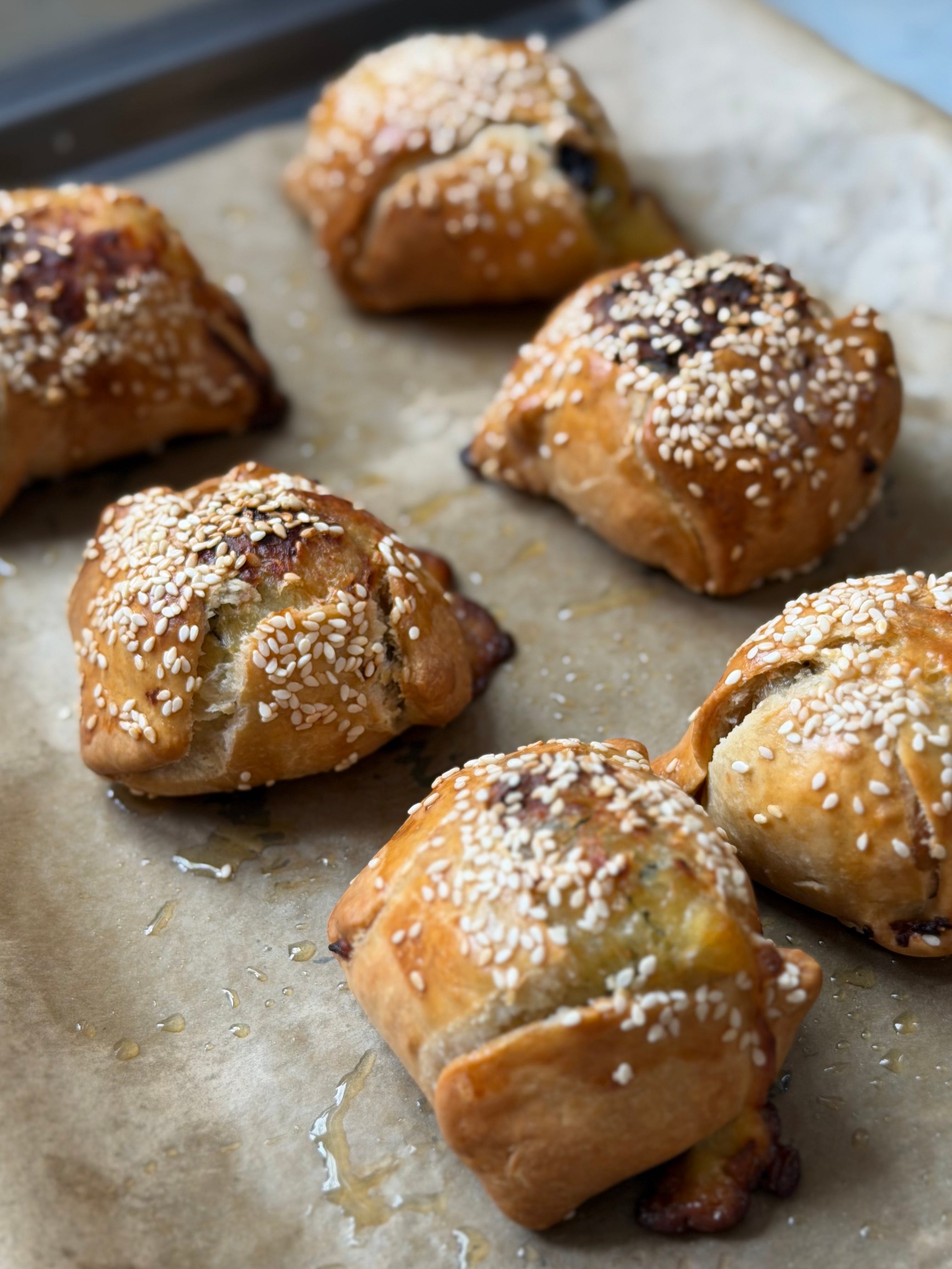
A cheese-filled pastry almost like a hand pie, it is quintessentially Cypriot and enjoyed by both Greek (GSC) and Turkish speakers (TSC) from the island, to celebrate Pascha and Bayram. Elders in my family, and those I have been chatting to at Hackney Cypriot Association this week like aunty Nursen, have spoken to me about flaouna/pilavuna swaps between GSC and TSC neighbours in a previous lifetime and whilst, as with any traditional food, there may be some slight regional or familial differences, the fundamentals are the same: sweetened cheese, eggs, semolina, fresh mint, raisins, mastic and mehlebi.
Today I’m sharing a recipe for my family’s version; a recipe that has gone somewhat full circle. It was passed down to my mum and, in turn, to me and my sisters, in the same way that all of these things are: as a list of words with an implied aunty-intuition for quantities and timings. I tried to shape this into a followable recipe during the pandemic, when I couldn’t spend Easter with my family and had to make them for myself, and alone for the first time. Since then, my mum and grandma have started following my version of the recipe, which gives me a certain satisfaction. Of course you can enjoy these bakes at any time, and I’d love to hear how it goes if you give them a try.
Recipe notes:
Using the quantities above, I make 20 flaounes because I like them small. Make 15 if you want them bigger.
Flaouna cheese is a relative of halloumi - a hard salted cheese made of goat and sheep milk - but is used only in the context of flaounes. It can be found in most Cypriot supermarkets.
Mastic and mehlebi (mahlab) can be found in some Mediterranean and SWANA supermarkets, or online.
You’re going to think you don’t have enough dough but you definitely do. It’s deliberately thin so that you don’t get really pastry-heavy and dry bakes. The filling-to-pastry ratio should tend towards more filling. Think of the dough as incidental; it’s a vehicle for cheese mixture and shouldn’t be the main feature.
Many happy memories of flounes made by my Cypriot friend Maria’s mum, dropped off at our house just before Orthodox Easter. Need to give your recipe a try.
Thank you for my flounes! I’m saving it to have tomorrow ❤️